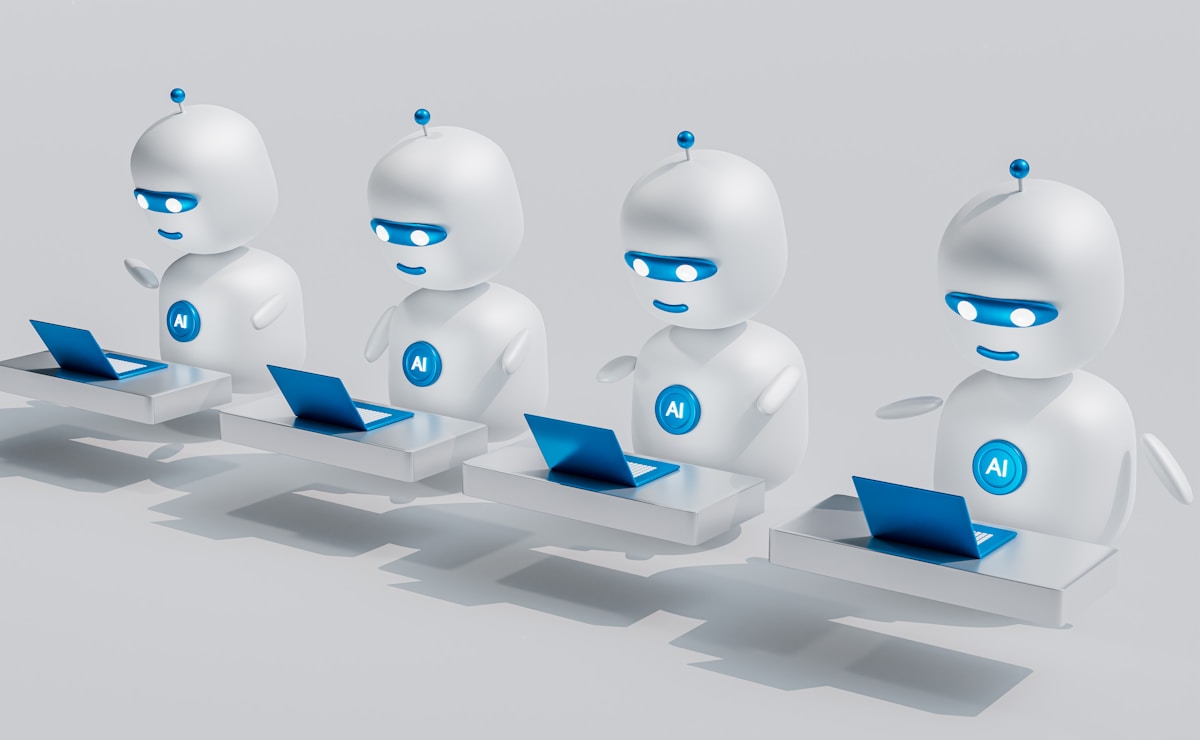
It is Monday morning. Before you have poured your first coffee, your AI agent has already rescheduled your dentist appointment to avoid the traffic conflict it spotted in your calendar.
It flagged a suspicious ₹3,200 overcharge on your credit card and raised a dispute automatically.
It ordered the groceries you were running low on, based on what it learned from your last three delivery orders. You did not ask for any of this. It just happened.
Chatbots Answer. Agents Act.
For years, we were told that chatbots were the future of customer service and personal productivity. And in a narrow sense, they were useful — you could ask them questions and get answers. But the analogy was always a receptionist. A good receptionist tells you where to go, what forms to fill, and who to call. They do not actually do anything for you.
An AI agent is not a receptionist. It is an executive assistant who has access to your calendar, your email, your accounts, and your preferences — and who can actually take action on your behalf. The shift sounds subtle. The implications are enormous.
When you ask a chatbot to help you reschedule a meeting, it might draft an email for you to send. When you tell an AI agent to reschedule a meeting, it opens your calendar, finds a mutual availability window, sends the invite, and confirms with both parties. No further input from you required.
What AI Agents Are Doing Right Now
OpenAI's Operator product — launched in January 2025 — can browse the web, fill forms, and complete multi-step tasks autonomously. A multi-leg international trip that might take a human 45 minutes across three websites can be handled by Operator with minimal human involvement. (Source: OpenAI product announcement, January 2025)
Anthropic's Claude agents are being deployed in business environments to handle customer support queues. They read incoming tickets, classify them by urgency, resolve standard queries without escalation, and draft responses for complex issues before flagging them for human review. The human handles the hard cases. The agent handles everything else.
In vendor management, AI agents are being used to analyse pricing histories, draft negotiation emails, and track responses — compressing work that previously took hours into an automated workflow. A 2023 peer-reviewed study by Brynjolfsson, Li, and Raymond at Stanford and MIT, published as NBER Working Paper 31161, measured AI assistant deployment across 5,179 customer support agents and found a 14% average increase in issues resolved per hour, with a 34% gain for less experienced workers. (Source: NBER Working Paper 31161, 2023)
Would You Let AI Pay Your Bills?
The trust question is real. And it sits along a spectrum. On the low-stakes end — ordering groceries, flagging a duplicate charge, rescheduling a routine appointment — most people are already comfortable delegating to AI. The cost of a mistake is small, and the convenience is high.
As the stakes rise, so does the need for human checkpoints. Most well-designed AI agents today operate in a confirm-before-act model for consequential decisions. The agent proposes. You approve. It executes. For a wire transfer above ₹10,000, you want to be in the loop. For renewing a streaming subscription, you probably do not.
Think about a typical workday with an AI agent in the mix. Morning: the agent has already sorted your email, highlighted the threads that need your attention, and drafted responses to the rest. Afternoon: it has updated your project tracker based on the status call you just had. Evening: it has flagged that your travel insurance needs renewal — waiting for your approval before clicking buy. You spent your day on actual work. The agent handled the rest.
"A chatbot waits to be asked. An agent figures out what needs to be done and does it."
Where This Is Heading in Two Years
The trajectory is clear. Within two years, agentic AI will be as mainstream in business operations as email is today. Every company of meaningful size will have AI agents running workflows — not as experimental pilots, but as core infrastructure.
We are already seeing the early version of this. Customer support queues that previously required large teams are being handled by hybrid human-AI systems. Finance teams that generated month-end reports manually are getting them automatically. The next phase is agents that collaborate with each other — one booking travel, another managing accommodation, a third updating the expense system, all coordinating without a human in the middle.
The businesses that build agentic systems now will have a compounding advantage. Every month of operation makes the agent smarter about that specific business — its preferences, its clients, its workflows. That institutional knowledge becomes a genuine competitive moat.
What This Means For You
If you are a business owner, the question is not whether to use AI agents. It is which workflows to automate first. Start with the tasks that are high-volume, rule-based, and time-consuming. Customer query triage. Invoice processing. Report generation. Appointment scheduling. Each one you automate gives your team hours back every week — hours they can spend on work that actually requires human judgment.
If you are an individual, start experimenting with agent-enabled tools now. The learning curve is low. The productivity gain is immediate. And the people who are comfortable working with AI agents in 2026 will be significantly more capable than those who are not by 2028.
The age of AI that just answers questions is already over. We are in the age of AI that gets things done.